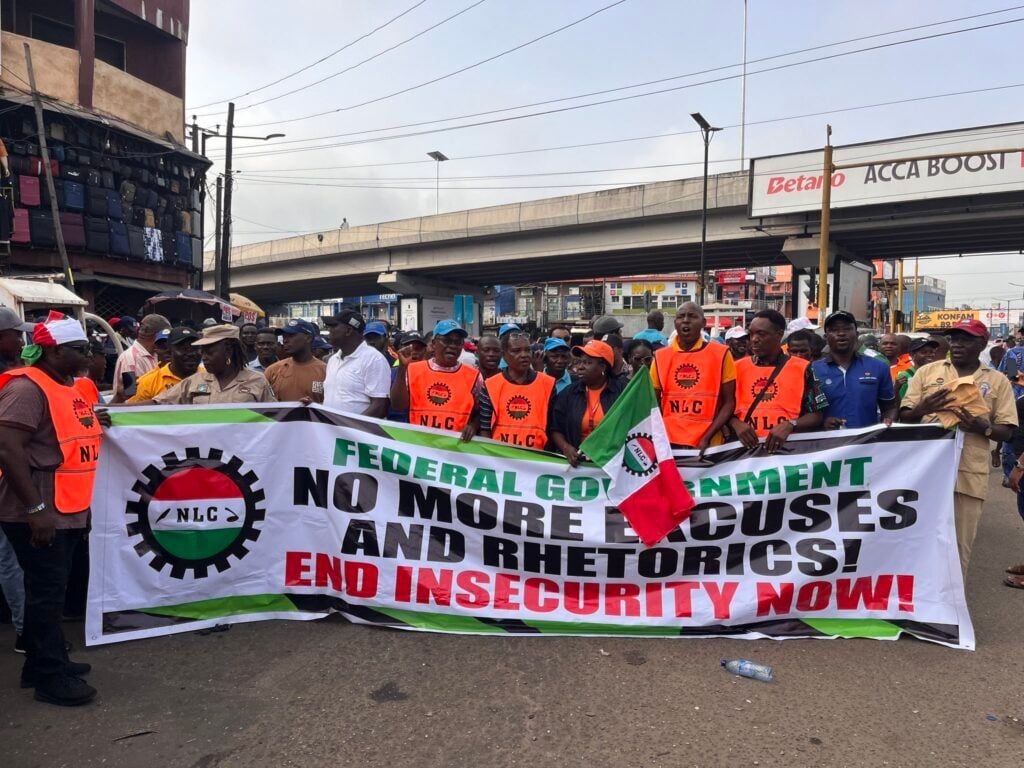
The Nigeria Labour Congress (NLC) on Wednesday staged coordinated protests across several parts of the country to express growing concern over the worsening security situation and to demand decisive action from government authorities to protect lives and property.
The protests, which took place simultaneously in major cities and state capitals, were organised by the NLC in collaboration with various civil society organisations, professional bodies and rights groups. The demonstrators decried what they described as the persistent failure of the state to curb insecurity, amid rising cases of terrorism, banditry, kidnapping, communal violence and violent crime nationwide.
Carrying placards with inscriptions such as “End Insecurity Now,” “Nigerians Deserve Safety,” and “Protect Lives and Livelihoods,” protesters marched through key roads, government secretariats and public spaces, calling attention to the daily toll of violence on workers, farmers, traders and ordinary citizens.
Related posts:
- Peter Obi laments rising insecurity, political instability, Says Nigeria has become a “Now Disgraced Nation”
- Atiku Abubakar Demands Full Disclosure from Federal Government Over Appointment of Xpress Payments for TSA Collection
- 25 students kidnapped from Government Girls Comprehensive Secondary School in Kebbi: A tragedy rooted in neglect and government failure
- PDP Chairman, Turaki leads delegation to visit former president Obasanjo
In Abuja, the federal capital, hundreds of protesters converged on strategic locations, chanting solidarity songs and urging the federal government to treat insecurity as a national emergency. Similar demonstrations were reported in Lagos, Ibadan, Benin City, Enugu, Owerri, Port Harcourt, Jos, Makurdi, Minna, Kaduna, Kano and several other cities.
Speaking to journalists during the protest in Abuja, NLC President Joe Ajaero said the labour movement could no longer remain silent while Nigerians continued to be killed, displaced and impoverished by insecurity. He described the situation as a direct threat to workers’ welfare, national productivity and social stability.
“Insecurity has reached an alarming level. Workers cannot go to work safely, farmers cannot go to their farms, traders are afraid to open their shops, and communities are living in fear,” Ajaero said. “The labour movement is saying enough is enough. Government must act decisively to protect citizens.”
He noted that insecurity had far reaching economic consequences, including rising food prices, job losses, disruption of supply chains and declining investment. According to him, workers bear the brunt of these challenges through inflation, loss of income and declining quality of life.
The NLC leader also expressed concern over the increasing number of internally displaced persons across the country, many of whom have lost their means of livelihood due to violence. He said the growing humanitarian crisis underscored the need for urgent and comprehensive security reforms.
In several states, NLC leaders submitted protest letters to government officials, outlining their demands and urging authorities to take immediate steps to restore peace. Among the key demands were improved intelligence gathering, better welfare for security personnel, community based policing, accountability for security failures and stronger collaboration between federal and state governments.
Civil society organisations that joined the protests echoed similar concerns. A representative of one of the participating groups said insecurity had eroded public trust in institutions and undermined democratic governance.
“When citizens are not safe, democracy is meaningless,” the activist said. “The right to life and security is fundamental, and the government has a duty to uphold it. These protests are a call for accountability and urgent action.”
In Lagos, protesters marched through parts of the city under tight security, as police officers monitored the situation to prevent any breakdown of law and order. There were no reports of violence or arrests, as the demonstrations remained largely peaceful.
Labour leaders in the state said kidnappings, cult violence and armed robberies had made daily life increasingly unsafe, particularly for workers commuting early in the morning or returning home late at night.
In the North Central and North West regions, protesters highlighted the impact of banditry and farmer herder conflicts on food production and rural livelihoods. According to them, many farmers have abandoned their farmlands due to fear of attacks, worsening food insecurity and contributing to rising prices across the country.
Similarly, demonstrators in the South East raised concerns over violent attacks, insecurity linked to separatist tensions and the economic consequences of frequent disruptions to commercial activities.
The NLC emphasised that the protests were not politically motivated but driven by genuine concern for the safety and well being of Nigerians. The congress warned that failure to address insecurity could further strain labour relations and social cohesion.
“We are not here to score political points,” Ajaero said. “We are here because lives are being lost daily. The government must rise to its responsibility.”
He added that labour unions would continue to engage government authorities through dialogue but would not rule out further actions if meaningful progress was not achieved.
The protests come amid mounting public frustration over the country’s security challenges, despite repeated assurances from government officials that measures are being taken to improve the situation. Recent months have seen renewed attacks in various parts of the country, including mass kidnappings, deadly ambushes and attacks on communities.
While security agencies have recorded some successes, critics argue that these gains have not been sufficient to reassure the public or stem the tide of violence.
As of the time of filing this report, the federal government had not issued an official response to the NLC led protests. However, security officials were seen maintaining order at protest locations, and state authorities acknowledged receipt of labour’s demands in some areas.
The NLC said it would closely monitor the government’s response and continue to mobilise workers and civil society groups in the struggle for a safer and more secure Nigeria.