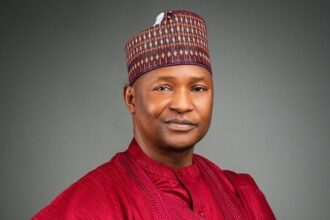
The President of the Nigerian Bar Association (NBA), Afam Osigwe, SAN, has expressed strong concerns over what he describes as the growing misuse of Nigeria’s Cybercrimes Act to suppress freedom of expression, warning that the law is increasingly being deployed as a political weapon rather than a legitimate tool for combating cyber-related offences.
Speaking during an interview on ARISE Television’s Prime Time programme on Wednesday, Osigwe criticised what he termed the “weaponisation” of the Cybercrimes (Prohibition, Prevention, etc.) Act against journalists, activists, political critics and ordinary citizens who express dissenting views, whether online or offline.
According to the NBA president, individuals are being investigated, charged and detained under allegations of cybercrime or criminal defamation in circumstances that suggest an intent to silence criticism rather than uphold justice. He noted that many of the alleged offences cited in such cases are ordinarily bailable, yet courts are increasingly denying bail without sufficient justification.
“Free speech is being muzzled in Nigeria under the guise of charging people to court and investigating them for cybercrime and criminal defamation,” Osigwe said. “Even when the matters are ordinarily bailable, judges and magistrates are increasingly appearing to be tools in the hands of politicians and ‘big men’ and refuse bail even where there is no basis for not granting bail.”
Osigwe warned that such developments pose a serious threat to Nigeria’s democratic framework, as they undermine constitutional guarantees of freedom of expression and due process. He argued that when the judicial system is perceived as aligning with powerful political interests to silence dissenting voices, it erodes public trust in both the courts and democratic institutions.
“This is a violation of the right to freedom of expression and an abuse of the democratic space,” he stated. “Public office holders should be held to a higher standard of accountability. If they deprive people of the ability to criticise and hold them to account, then democracy dies.”
The senior advocate emphasised that criticism of government officials, policies and public institutions is a fundamental component of any functioning democracy. He cautioned that suppressing such criticism through legal intimidation not only chills public discourse but also weakens institutional checks and balances.
Osigwe further contended that when judges and magistrates appear to facilitate such suppression—particularly by denying bail in cases that do not warrant prolonged detention—the judiciary risks being viewed as complicit in undermining civil liberties.
“If our judges become willing tools in giving them that which they desire, which is to put those people out of circulation, then there’s something wrong,” he said. “The judiciary becomes a willing tool in the hands of the oppressors and thereby becomes an oppressor itself.”
The NBA president’s remarks come amid sustained public debate about the scope and application of the Cybercrimes Act. Originally enacted in 2015 and amended in 2024, the legislation was designed to address emerging threats such as online fraud, identity theft, cyberterrorism and other technology-driven crimes. However, critics have consistently raised concerns about certain provisions of the law—particularly those relating to “cyberstalking” and online defamation—which they argue are vaguely defined and susceptible to abuse.
Legal analysts have pointed out that broadly worded clauses can allow law enforcement agencies to interpret critical commentary, investigative reporting or social media posts as criminal conduct. In recent years, there have been multiple instances in which journalists and social media users were arrested or prosecuted under the Act after publishing allegations of corruption or misconduct against public officials.
Supporters of the law maintain that it is necessary to address genuine cyber threats and protect individuals from harassment and malicious online attacks. However, civil society groups and members of the legal community have called for clearer definitions, stricter safeguards and stronger judicial oversight to prevent misuse.
Osigwe’s intervention adds the weight of the NBA’s leadership to calls for reform and responsible application of the law. As head of the country’s foremost professional body for lawyers, his comments underscore growing concern within the legal profession about the balance between national security objectives and constitutional freedoms.
He urged stakeholders—including the judiciary, law enforcement agencies and lawmakers—to reflect on the long-term implications of curbing free expression through expansive interpretations of cybercrime legislation. In his view, safeguarding democratic space requires vigilance not only against criminal activity but also against institutional overreach.
As discussions about the Cybercrimes Act continue, Osigwe’s remarks have reignited debate over how best to protect both digital security and fundamental rights in an increasingly connected society.