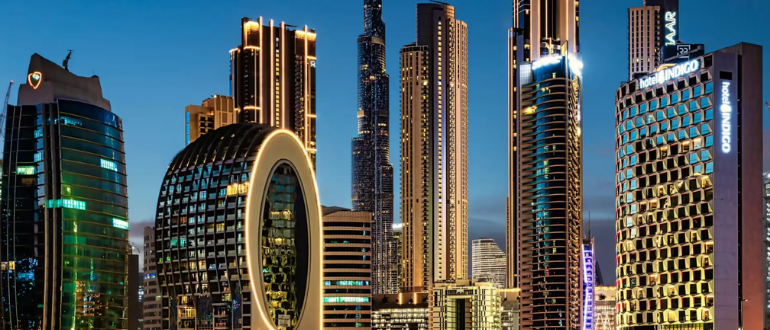
Dubai’s real estate sector, long regarded as one of the most resilient and attractive property markets globally, is beginning to show early signs of stress as geopolitical tensions in the Middle East intensify. Analysts are reporting a notable decline in transaction volumes, alongside emerging price adjustments, as uncertainty surrounding the conflict involving Iran, the United States and Israel weighs on investor confidence across the Gulf region.
According to data compiled by Goldman Sachs, real estate transaction volumes in the United Arab Emirates declined sharply in the first 12 days of March. The figures show a 37 per cent drop year-on-year and a steeper 49 per cent decline compared to the previous month. These numbers represent one of the most significant short-term contractions in recent years and suggest that the unfolding conflict is beginning to influence buying behaviour in Dubai’s property market.
Dubai has built a reputation over the past decade as a safe haven for global capital, particularly during periods of international instability. Wealthy individuals, institutional investors and expatriates have consistently turned to the emirate for its political stability, business-friendly regulations and tax advantages. However, the recent escalation in regional hostilities — including strikes that have affected parts of the Gulf region — has introduced a new layer of uncertainty.
The psychological impact of geopolitical risk appears to be filtering into property listings. Several real estate agents have reported price reductions ranging from 12 to 15 per cent in selected segments of the market. In one instance, a residential unit located near the iconic Burj Khalifa was offered at $650,000, down from a previous asking price of $735,000. Similarly, an off-plan apartment on Palm Jumeirah — one of Dubai’s most prestigious waterfront developments — was reportedly reduced to approximately $2 million.
These adjustments mark a notable shift from the aggressive price appreciation witnessed in recent years. Dubai’s property market had experienced sustained growth, driven largely by an influx of high-net-worth individuals relocating from Europe, Asia and other parts of the Middle East. The emirate’s zero income tax regime, flexible visa policies and investor-friendly regulatory framework contributed to robust demand, particularly in the luxury and ultra-luxury segments.
The present slowdown therefore represents a reversal of strong post-pandemic momentum. Following global disruptions in 2020, Dubai emerged as a preferred destination for investors seeking stability and lifestyle advantages. Transaction volumes and property prices rose significantly between 2021 and 2024, with prime areas recording double-digit annual growth. The market’s performance was further supported by population expansion, as expatriates and entrepreneurs established residency in the emirate.
However, the ongoing conflict has introduced risk factors that were previously considered remote. While Dubai itself has not been directly impacted by large-scale hostilities, the broader regional security environment has shifted. Investors who once viewed the emirate as insulated from geopolitical turbulence are now reassessing their exposure.
The impact is also visible in the equity market. Shares of Emaar Properties, the flagship developer responsible for landmark projects including the Burj Khalifa, have fallen more than 26 per cent since the conflict escalated. The decline reflects broader investor concerns about the sustainability of property demand under conditions of heightened uncertainty.
Analysts at Citigroup have cautioned that the war presents “considerable risk” to Dubai’s growth trajectory. Their assessment suggests that prolonged instability could slow population growth — a key driver of housing demand — and moderate investor appetite in both residential and commercial segments. In a pessimistic or “bearish” scenario, Citigroup forecasts that annual property prices could decline by as much as 7 per cent in the coming years.
Such projections underscore the sensitivity of Dubai’s real estate market to external shocks. Although the emirate’s economic fundamentals remain relatively strong, property values are closely tied to capital flows, expatriate migration patterns and global investor sentiment. A sustained period of geopolitical tension could dampen all three.
Despite these warning signs, market activity has not come to a complete halt. Industry insiders report that high-value transactions continue to occur, particularly among investors with long-term perspectives or diversified global portfolios. Notably, mixed martial arts champion Francis Ngannou was reported to have acquired a luxury property on Palm Jumeirah during this period, highlighting that demand at the top end of the market remains present.
This divergence in behaviour reflects a broader segmentation within Dubai’s property market. Some buyers are adopting a cautious stance, delaying decisions or negotiating aggressively in anticipation of further price corrections. Others, particularly those with substantial liquidity, are viewing the current environment as an opportunity to secure premium assets at discounted rates.
Agents report that opportunistic investors are increasingly active, seeking distressed or motivated sellers. In volatile markets, such buyers often play a stabilising role by providing liquidity. However, their presence also reinforces the perception that the market is entering a corrective phase.
For developers, the challenge lies in balancing pricing strategies with project pipelines. Off-plan developments — a major feature of Dubai’s property ecosystem — are particularly sensitive to confidence levels. If buyers become hesitant to commit to projects under construction, developers may need to offer incentives, flexible payment plans or price reductions to sustain sales momentum.
The coming months will likely serve as a crucial test for Dubai’s real estate resilience. Historically, the emirate has demonstrated an ability to recover from cyclical downturns, supported by proactive government policies and infrastructure investment. Yet the current environment differs in that it is shaped by geopolitical variables beyond local control.
Much will depend on the duration and intensity of the regional conflict. A swift de-escalation could restore confidence and stabilise transaction volumes. Conversely, prolonged instability may exert sustained pressure on prices and developer balance sheets.
For now, the data points to an inflection moment. Transaction volumes have declined sharply, selective price discounts are emerging, and market sentiment has turned more cautious. While the long-term structural appeal of Dubai — including its strategic location, modern infrastructure and investor-friendly framework — remains intact, the sector is navigating a period of heightened vulnerability.
In sum, Dubai’s property market is undergoing a stress test triggered by geopolitical instability. The interplay between investor psychology, capital flows and regional security dynamics will determine whether this slowdown evolves into a broader correction or remains a temporary disruption. What is clear, however, is that one of the world’s most high-profile real estate markets is no longer immune to the shifting tides of regional conflict.