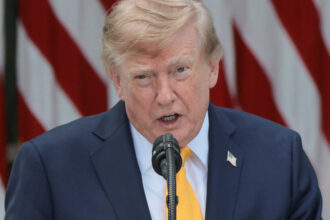
U.S. President Donald Trump has ignited fresh controversy after alleging that a report broadcast by CNN was sourced from what he described as a “fake news site from Nigeria,” as he pushed back against claims that Iran had secured victory following a recent ceasefire agreement.
The remarks were made in a series of posts on Trump’s Truth Social platform on Wednesday, coming shortly after he announced a two-week ceasefire between the United States and Iran aimed at easing tensions and reopening critical maritime routes.
Responding to a statement attributed to Iranian authorities and circulated by CNN, Trump dismissed the report outright, describing it as fraudulent. He argued that the network knowingly aired false information, claiming that the source material did not originate from official Iranian channels.
According to Trump, the disputed statement had been linked to what he termed a “fake news site” allegedly based in Nigeria. He further alleged that the report was quickly amplified by CNN and presented as a legitimate headline without proper verification. In his view, the network’s actions misrepresented Iran’s official position and risked escalating an already delicate geopolitical situation.
“The alleged statement put out by CNN World News is a fraud, as CNN well knows,” Trump said, insisting that the version circulated did not accurately reflect Tehran’s official communication. He maintained that the authentic Iranian position had been separately released and shared through his own platform.
In a follow-up post, Trump intensified his criticism, accusing CNN of deliberately disseminating a “false and dangerous statement” under the guise of official Iranian communication. He suggested that the report may have been intended to inflame tensions at a sensitive moment in ongoing diplomatic efforts.
He also alleged that the origin of the report could be traced to “a new, trouble-making site from Nigeria,” though he did not provide any verifiable evidence to substantiate the claim. Trump further stated that authorities were examining whether any legal violations had occurred in the publication and distribution of the disputed information.
Calling for accountability, Trump demanded that CNN immediately retract the report and issue a formal apology. He described the network’s actions as part of a pattern of what he characterised as poor and misleading reporting.
The controversy centres on a statement reportedly issued by Iran’s Supreme National Security Council, which suggested that Tehran had achieved a “historic and crushing defeat” of the United States and had compelled Washington to accept elements of its negotiation framework. The claim, widely circulated in international media, was interpreted by some analysts as part of Iran’s domestic messaging following the ceasefire.
However, Trump firmly rejected that narrative, insisting that the official Iranian position did not support such claims of victory. He argued that the version promoted by CNN was inaccurate and misleading, further deepening the dispute between the administration and the media outlet.
The mention of Nigeria in Trump’s remarks has drawn particular attention, especially given the lack of supporting evidence for the allegation. The claim has sparked discussion both within Nigeria and internationally, with observers questioning the basis for linking the report to a Nigerian platform.
Backing Trump’s position, Brendan Carr, Chairman of the Federal Communications Commission, criticised CNN’s handling of the story. He argued that the dissemination of potentially false information during a sensitive national security moment warranted serious scrutiny.
Carr emphasised that while misinformation is problematic in general, its impact is significantly amplified in the context of international conflict, where inaccurate reporting can influence public perception and diplomatic dynamics.
Despite the mounting criticism, CNN has firmly stood by its reporting and rejected calls for a retraction. A spokesperson for the network stated that the report was based on information obtained directly from Iranian officials known to the organisation, and that the content had been corroborated by multiple Iranian state media outlets.
According to the network, versions of the same statement were widely circulated across Iranian platforms in both English and Farsi, reinforcing its credibility at the time of publication. CNN maintained that its editorial processes adhered to established journalistic standards, including source verification and cross-checking.
The network stressed that its report reflected what was communicated by Iranian authorities at the time, and that it acted in accordance with standard newsroom practices. It also rejected suggestions that it knowingly broadcast false information.
The dispute comes against the backdrop of broader global reactions to the ceasefire agreement between the United States and Iran. The truce, announced shortly before a deadline set by Trump for potential military action, has been widely viewed as a critical step toward de-escalating tensions in the region.
Both Washington and Tehran have since sought to frame the outcome in their favour, each claiming some degree of strategic success. This competing narrative has contributed to the confusion surrounding official statements and media interpretations, further complicating the information environment.
The ceasefire also carries significant implications for global energy markets, particularly due to the strategic importance of the Strait of Hormuz. The waterway, through which a substantial portion of the world’s oil supply passes, had been disrupted during the conflict, raising concerns about supply stability and economic impact.
As part of the ceasefire arrangement, Iran’s Foreign Minister, Abbas Araghchi, confirmed that safe passage through the strait would be guaranteed for the duration of the two-week truce. This development has been welcomed by international stakeholders as a positive, albeit temporary, step toward restoring normalcy.
However, the ongoing dispute between Trump and CNN underscores the challenges of information management in times of geopolitical tension. Conflicting narratives, disputed sources, and rapid dissemination of reports through global media channels can create an environment where clarity is difficult to achieve.
In this case, the disagreement highlights broader questions about media credibility, source verification, and the role of political actors in shaping public discourse. It also underscores the sensitivity of international reporting, particularly when it involves high-stakes issues such as war, diplomacy, and national security.
As investigations into the origin and accuracy of the disputed statement continue, the episode serves as a reminder of the critical importance of reliable information in an increasingly interconnected and volatile global landscape.