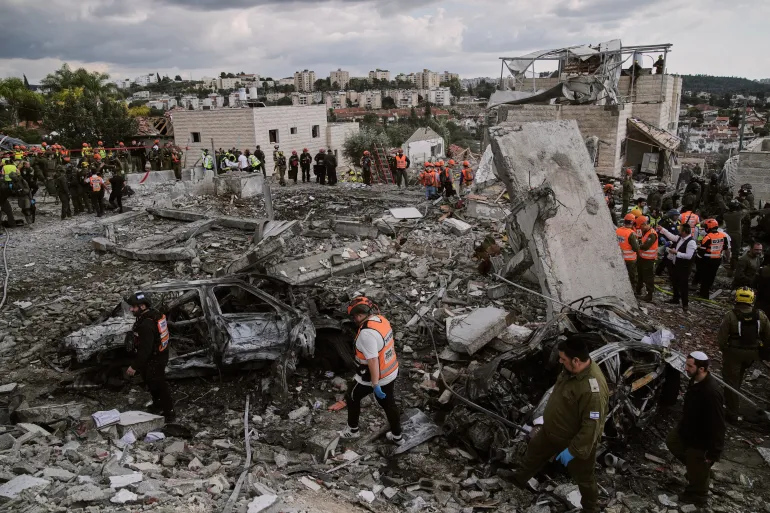
At least nine people have been killed following an Iranian ballistic missile strike on the central Israeli city of Beit Shemesh, marking the deadliest single incident inside Israel since the latest round of hostilities began. The attack comes as Tehran intensifies retaliatory operations a day after its Supreme Leader, Ali Khamenei, was killed in coordinated US-Israeli strikes.
Israel’s national emergency service, Magen David Adom (MDA), confirmed on Sunday that nine people lost their lives in the missile impact, while 28 others were injured. Among the wounded, two were reported to be in serious condition.
The Israeli military said search-and-rescue teams were deployed immediately to the impact site in Beit Shemesh, supported by air evacuation units. In a statement, the Israel Defense Forces (IDF) noted that a helicopter was assisting in transporting critically injured victims to nearby hospitals. Military officials added that an internal review was underway to determine the precise circumstances surrounding the missile’s penetration of Israel’s air defense systems.
Beit Shemesh, located west of Jerusalem, experienced significant structural damage, with several residential buildings partially collapsed. Emergency responders continued working through the rubble hours after the strike, raising fears that the casualty toll could increase.
Reporting from Ramallah in the occupied West Bank, Al Jazeera correspondent Nour Odeh described the incident as Israel’s “highest casualty count” since the current escalation began. She noted that residents were particularly alarmed by reports that air raid sirens did not activate before the missile struck.
“What is worrying residents right now is that rescue workers are still working to rescue people trapped under the rubble,” Odeh said. “There are concerns and fear that this count may rise. And there are questions as to why the sirens did not go off in Beit Shemesh.”
The strike has heightened scrutiny of Israel’s missile defense architecture, which includes systems designed to intercept incoming ballistic and cruise missiles. While the IDF has successfully intercepted numerous projectiles in recent days, officials acknowledged that no system is infallible.
Analysts suggest that Iran’s strategy may involve saturating Israeli defenses with sustained missile and drone launches, increasing the probability that some projectiles evade interception. The Beit Shemesh strike, along with earlier impacts in Tel Aviv, underscores the inherent risks of prolonged missile exchanges.
The current escalation follows a dramatic shift in the conflict after Israel and the United States carried out extensive strikes inside Iran on Saturday. Those operations reportedly targeted senior Iranian officials and military facilities, culminating in the killing of Khamenei and other high-ranking figures.
Iran has since declared a 40-day national mourning period. Speaking to Al Jazeera, Iran’s Foreign Minister Abbas Araghchi warned that the killing of the Supreme Leader would “make the confrontation more complex and dangerous.”
“We have no restrictions or limits in defending ourselves,” Araghchi said, emphasizing that Tehran would respond decisively. He dismissed suggestions that external military pressure could destabilize Iran’s political system. “If their goal is to change our regime, this is an impossible task. We have a solid system and a strong constitution.”
Iranian President Masoud Pezeshkian echoed that message in a televised address, declaring that despite Khamenei’s death, Iran would continue along the path he charted. He vowed that the country’s adversaries would ultimately be left “hopeless.”
Inside Israel, the deadly strike has intensified public debate about the strategic calculus behind initiating direct military confrontation with Iran. Some residents in affected areas have voiced concern over the frequency and scale of incoming missile attacks.
Security officials argue that failing to respond forcefully to Iranian military expansion would pose a longer-term existential threat. However, the immediate human cost has become starkly visible as rescue teams continue combing through debris in Beit Shemesh.
The IDF has signaled that further operations against Iranian targets remain possible, while reinforcing air defenses and mobilizing additional units along key fronts. Meanwhile, Tehran’s vow of unlimited retaliation suggests that missile exchanges may continue in the coming days.
As both sides escalate rhetoric and military action, civilians are bearing the brunt of the confrontation. In Beit Shemesh, emergency crews remain at work amid shattered concrete and twisted metal — a grim illustration of how swiftly regional tensions have translated into deadly consequences on the ground.