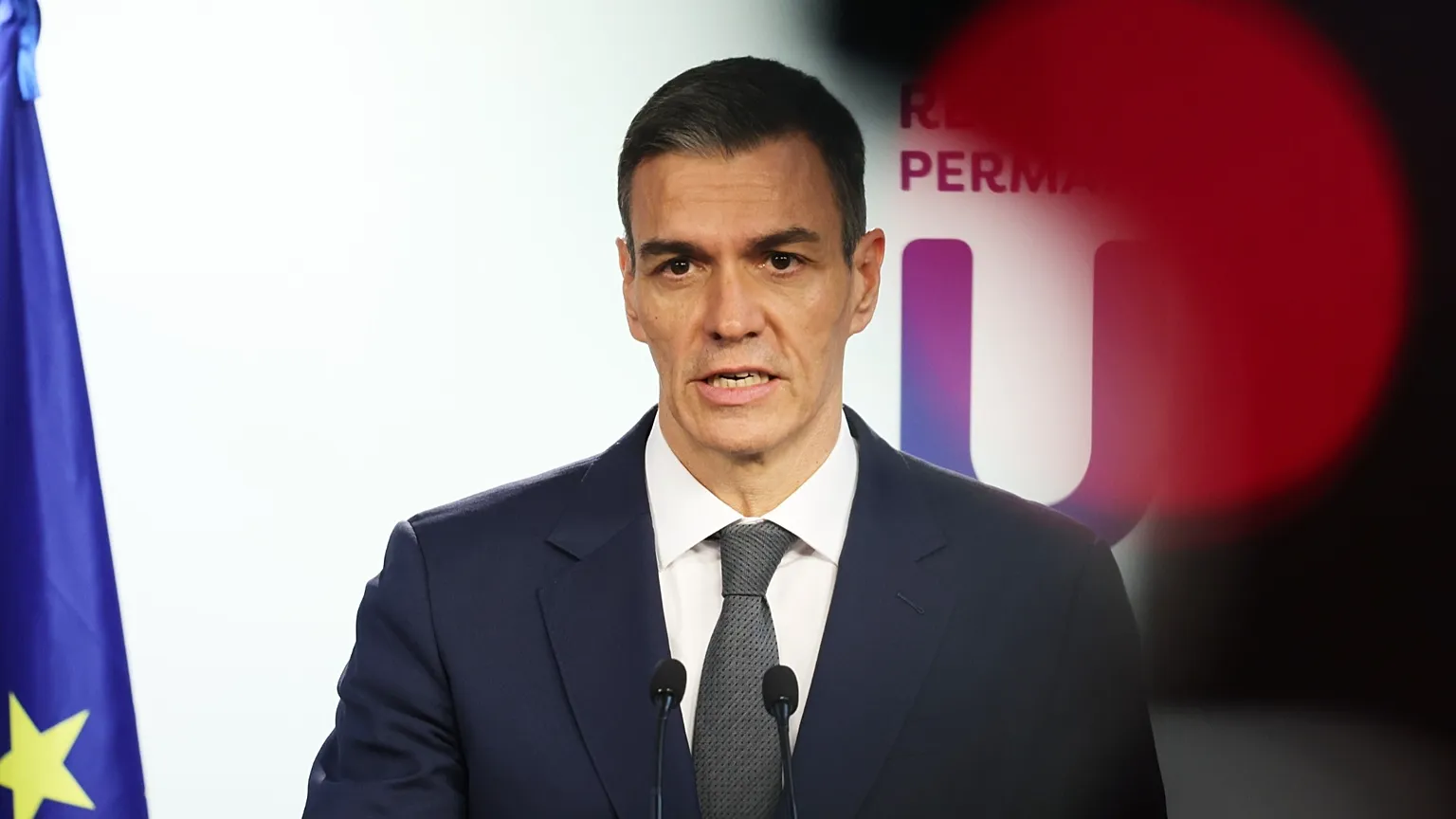
Spain has once again distinguished itself within Europe as one of the most outspoken critics of US foreign policy, Israel’s military operations in Gaza, and Iran’s repression of anti-government protests. Prime Minister Pedro Sánchez delivered a forceful condemnation of the latest joint US-Israeli strikes on Iran, warning that such actions risk deepening instability and accelerating the erosion of the international order.
In a sharply worded statement posted on X, Sánchez rejected what he described as “unilateral military action” by the United States and Israel. He argued that the strikes represent a dangerous escalation and contribute to “a more uncertain and hostile international order.” His reaction stood in contrast to the more measured tone adopted by many other Western leaders, who emphasized restraint, civilian protection, and adherence to international law without directly censuring Washington or Tel Aviv.
The controversy followed large-scale airstrikes reportedly conducted by the United States and Israel across Iran. Among the reported targets was a facility in central Tehran believed to be connected to Iran’s Supreme Leader, Ali Khamenei. The targeting of a site linked to the 86-year-old cleric marked a dramatic escalation in a conflict that has rapidly expanded across the Middle East.
At the European Union level, reactions were more restrained. Ursula von der Leyen, President of the European Commission, and António Costa, President of the European Council, issued a joint declaration describing the situation as “deeply concerning.” They called on all parties to avoid further escalation and to safeguard the global non-proliferation framework.
Similarly, Emmanuel Macron characterized the strikes as an “outbreak of war” with potentially grave implications for international peace and security. He announced that France would seek an urgent meeting of the United Nations Security Council to address the rapidly deteriorating situation.
Sánchez, however, went further than most of his European counterparts. While condemning the US-Israeli operation, he also criticized Iran’s leadership and the Islamic Revolutionary Guard Corps (IRGC), urging immediate de-escalation and full respect for international law. His balanced but firm approach reflects Spain’s evolving foreign policy posture: assertive, multilateralist, and increasingly independent within the European bloc.
Spain’s stance is consistent with a broader recalibration of its diplomatic identity. Under Sánchez, Madrid has sought to position itself as a principled advocate for international law and as a bridge between Europe and the Arab world. Spain was among the earliest countries to decline participation in a US-led “Board of Peace” initiative aimed at reconstructing Gaza, citing concerns about alignment with United Nations frameworks and international legal norms.
Sánchez has repeatedly described the humanitarian crisis in Gaza in stark terms, at one point referring to it as a “genocide.” At the same time, he has supported efforts within the European Union to designate Iran’s IRGC as a terrorist organization, reflecting Madrid’s willingness to criticize Tehran’s domestic repression and regional military activities.
This dual-track approach—critical of both Washington and Tehran—illustrates Spain’s attempt to anchor its foreign policy in normative principles rather than geopolitical alignment. Analysts note that Madrid’s rhetoric frequently emphasizes multilateral diplomacy, UN legitimacy, and compliance with international humanitarian law.
Spain has also invested heavily in strengthening its ties with Gulf and Arab states. Sánchez participated as a special guest at the 34th Summit of the League of Arab States in Baghdad last year, signaling Spain’s growing engagement with the Arab diplomatic sphere. More recently, he attended a high-level summit in Dubai, further reinforcing economic and political ties with Gulf nations.
Madrid has positioned itself as a consistent advocate for the Palestinian cause, arguing that a two-state solution remains the only viable path to sustainable peace in the Middle East. In 2024, Spain formally recognized the Palestinian state in a significant diplomatic move that underscored its departure from more cautious European approaches. France followed with recognition the following year.
In December, Palestinian President Mahmoud Abbas met Sánchez in Madrid, praising Spain’s advocacy for a ceasefire and its support for Palestinian statehood. The meeting reinforced Spain’s self-appointed role as a mediator and moral voice in the conflict.
Critics of Sánchez’s approach argue that Spain risks isolating itself within NATO and the European Union by openly rebuking Washington. Supporters counter that Madrid is exercising strategic autonomy, enhancing its credibility in the Global South and strengthening its diplomatic leverage.
The current crisis underscores the delicate balancing act Spain is attempting to maintain. By condemning the US-Israeli strikes while simultaneously criticizing Iran’s leadership, Sánchez has sought to project consistency: opposition to unilateral military escalation, regardless of the actor, and a demand for adherence to international legal norms.
As tensions continue to rise across the Middle East, Spain’s assertive diplomacy may signal a broader shift within parts of Europe toward more independent foreign policy positions. Whether Madrid’s stance will influence wider EU consensus remains uncertain. What is clear is that Spain has firmly established itself as one of the continent’s most vocal and principled commentators on the unfolding conflict—advocating de-escalation, multilateral engagement, and respect for international law in an increasingly volatile global landscape.