The Israel Defense Forces (IDF) has confirmed carrying out extensive air and naval strikes against Hezbollah targets in Lebanon after the Iranian-backed Shia armed group said it launched rockets and drones toward the northern Israeli city of Haifa.
Hezbollah described its attack as retaliation for the killing of Iran’s Supreme Leader, Ali Khamenei, whose death has triggered sharp escalation across the region. The group said its barrage was aimed at a missile defence installation south of Haifa and framed the operation as revenge for what it called Khamenei’s “pure blood,” as well as for continued Israeli strikes in Lebanon following the collapse of a ceasefire agreement reached in November 2024.
According to Lebanon’s health ministry, at least 31 people were killed in Israeli strikes targeting Beirut’s southern suburbs — an area known as Dahieh, where Hezbollah maintains a strong presence — as well as parts of southern Lebanon. Dozens more were reportedly injured as explosions rocked densely populated neighborhoods in the early hours of Monday.
Air raid sirens sounded across northern Israel shortly after 01:00 local time, with residents reporting multiple explosions. The IDF said one projectile crossing from Lebanon was intercepted, while others landed in open areas. No casualties or significant damage were reported inside Israel.
Hezbollah’s military wing later announced that it had launched “a barrage of rockets and a swarm of drones,” asserting that the attack was both symbolic and strategic. The group accused Israel and the United States of broadening their campaign against Iran and its regional allies.
Israel’s Defence Minister, Israel Katz, responded with a stark warning, vowing that Hezbollah would pay a “heavy price.” He said he had instructed the military to act forcefully and declared Hezbollah’s leader, Naim Qassem, a “marked target for elimination.”
The escalation follows a joint US-Israeli strike on Iranian leadership and military facilities over the weekend, an operation that significantly widened the conflict. Iran responded by launching missiles and drones toward Israeli territory and Gulf Arab states hosting US military bases, raising fears of a broader regional war.
Lebanon’s Prime Minister, Nawaf Salam, condemned Hezbollah’s actions as “irresponsible” and announced that his government was banning the group’s military activities. His remarks signaled growing domestic concern in Lebanon about being drawn into a multi-front war.
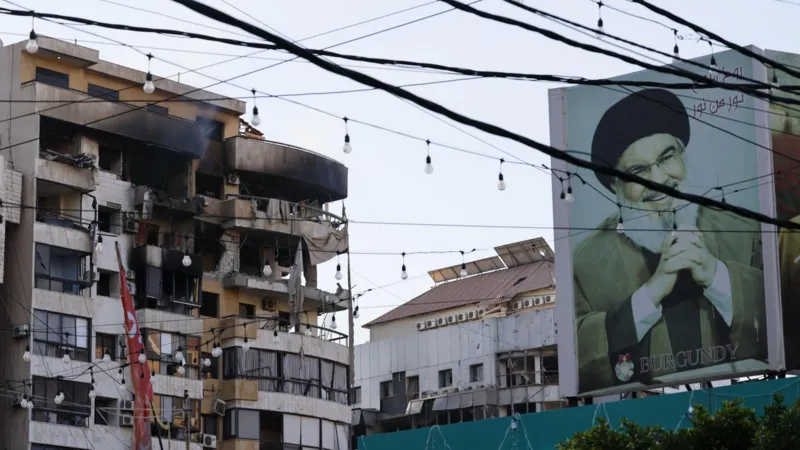
In Beirut’s southern suburbs, scenes of devastation unfolded overnight. Thick plumes of smoke rose above Dahieh as buildings caught fire. Roads near Beirut’s international airport were hit, leaving shattered glass and debris strewn across major thoroughfares. Residents fled en masse, creating gridlock along highways leading north.
Zeinab, a schoolteacher from Dahieh, described the terror of the night. She said she initially tried to ignore reports that Hezbollah had fired rockets at Israel. “We thought we would wait until morning to decide whether to leave,” she said. Moments later, Israeli strikes began.
“The house was shaking around us,” she recounted. “I told my daughter we might not survive.” She and her child fled on foot, unsure where to go. “We are exhausted. Our children should not carry the burden of wars that have nothing to do with them.”
In southern Lebanon, the IDF ordered evacuations in more than 50 villages, warning residents of additional strikes targeting weapons storage sites and launch platforms. By Monday afternoon, the Israeli military said it had struck more than 70 Hezbollah facilities, including missile launchers and command centers. Lebanese sources reported that Hussein Meklad, described as head of Hezbollah’s intelligence headquarters, was among those killed, though this has not been independently confirmed.
Across the border in northern Israel, residents braced for further attacks. In the town of Metula, streets were largely empty as families sheltered indoors. Levav Weinberg, who returned home last year after evacuating during the previous Hezbollah conflict, said his family spent the night in a reinforced safe room.
“Hezbollah rockets are not the same as Iranian rockets,” he said. “An Iranian missile could level an entire house.” He added that confronting Hezbollah ultimately meant confronting Iran, which he described as the “heart” of the network of hostile groups surrounding Israel.
Israel’s military leadership has indicated that the campaign is far from over. IDF Chief of Staff Lt. Gen. Eyal Zamir told officers that an “offensive campaign” against Hezbollah had begun and warned of prolonged combat. Later, he declared that the operation would end not only with Iran being struck but with Hezbollah suffering a “devastating blow.”
IDF spokesperson Brig. Gen. Effie Defrin said troops had been deployed along the northern border to prepare for “all possibilities.” When asked whether Israel was considering a new ground invasion of southern Lebanon, he replied that “all options” were on the table.
As the conflict intensifies, regional and international observers warn that the rapid escalation risks engulfing multiple countries. With Hezbollah openly aligning itself with Iran’s retaliation campaign and Israel signaling readiness for sustained military operations, the fragile stability that followed the 2024 ceasefire appears to have collapsed entirely.
For civilians on both sides of the border, the immediate concern remains survival — as air raid sirens, evacuation orders, and retaliatory strikes define yet another chapter in a long-running and increasingly volatile confrontation.