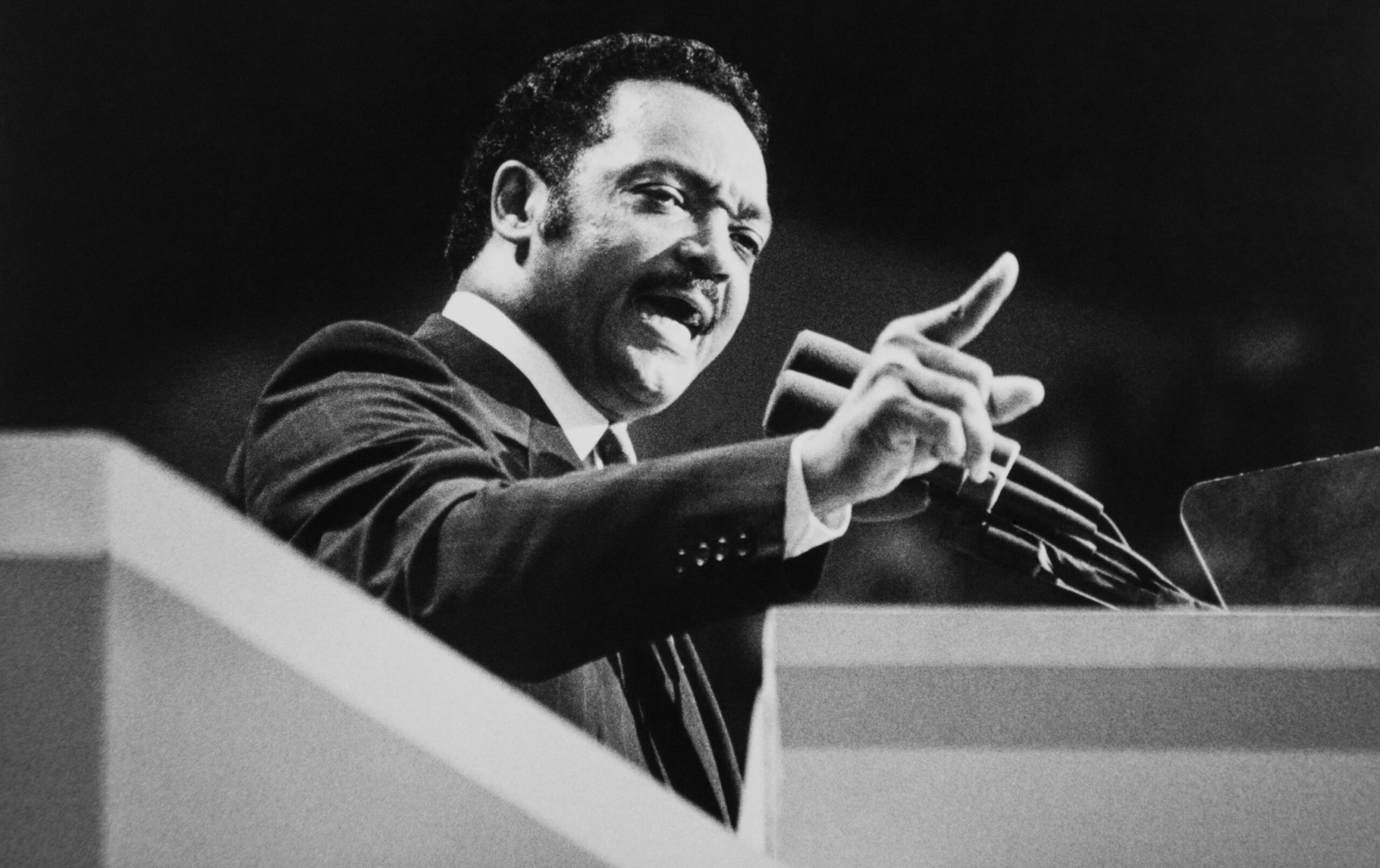
The Rev. Jesse Jackson, a towering figure in the American civil rights movement for more than half a century and a two-time contender for the Democratic presidential nomination, has died at the age of 84.
His family confirmed his passing in a statement, describing him as a “servant leader” devoted not only to his relatives but to “the oppressed, the voiceless, and the overlooked around the world.” They urged supporters to honour his memory by continuing the struggle for justice, equality and love that defined his life’s work. No official cause of death was disclosed.
Jackson had lived for over a decade with progressive supranuclear palsy (PSP), a rare neurological disorder initially diagnosed as Parkinson’s disease. In recent years, he had also been hospitalised twice with Covid-19.
For decades, Jackson stood at the centre of the fight for racial equality in the United States. Emerging from the crucible of the 1960s civil rights movement, he worked closely with the Rev. Martin Luther King Jr. and later became one of the most recognisable Black political leaders in America.
Born on 8 October 1941 in Greenville, South Carolina, Jackson came of age in the segregated American South. He excelled academically and athletically at Sterling High School, an all-Black institution, where he was elected class president. In 1959, he received a football scholarship to the University of Illinois. Though the Chicago White Sox reportedly offered him a place on their baseball team, Jackson chose to prioritise his education.
During his freshman year, a formative moment shaped his activism. Denied access to the whites-only Greenville public library while home for winter break, Jackson returned months later with seven other Black students to stage a peaceful sit-in. The group, later known as the Greenville Eight, were arrested for disorderly conduct but ultimately succeeded when a judge ruled they had the right to use the publicly funded facility. The Greenville library system was integrated in September 1960.
Jackson later transferred to North Carolina Agricultural and Technical College in Greensboro, where he earned a sociology degree, played quarterback, became a national officer in the Omega Psi Phi fraternity, and was elected student body president. He continued his activism through sit-ins at segregated restaurants, honing the leadership style that would define his career.
He first met King in the early 1960s and soon joined the Southern Christian Leadership Conference (SCLC), which King co-founded. In 1965, Jackson travelled to Selma, Alabama, after watching news footage of “Bloody Sunday,” when peaceful marchers were attacked by law enforcement officers on the Edmund Pettus Bridge.
Impressed by Jackson’s leadership abilities, King entrusted him with increasing responsibility within the movement. Jackson later led Operation Breadbasket, an SCLC economic justice initiative that leveraged the moral authority of Black churches to pressure corporations into hiring more African Americans through negotiation and boycotts. In 1967, he became the program’s national director and was ordained a minister the following year.
On 4 April 1968, Jackson was present at the Lorraine Motel in Memphis, Tennessee, when King was assassinated. The traumatic event marked a turning point in his life. He often reflected on the profound loss, describing it as a painful reminder that “a man of love is killed by hate.”
After King’s death, Jackson continued with the SCLC before founding People United to Save Humanity (PUSH) in 1971, focusing on improving economic conditions for Black Americans. The organisation launched youth reading programs, job placement initiatives and corporate advocacy campaigns. In the mid-1990s, PUSH merged with the National Rainbow Coalition to form the Rainbow PUSH Coalition, a multiracial movement advocating educational access, economic justice and voting rights.
Jackson broke new ground in national politics. In 1984, he became the second Black candidate to mount a nationwide campaign for the Democratic presidential nomination, following Shirley Chisholm. Though he lost the nomination to former Vice-President Walter Mondale, his campaign mobilised millions and expanded the political base of the Democratic Party.
He ran again in 1988, mounting a formidable campaign that shifted Black political influence from the party’s margins toward its centre. Though he ultimately lost to Massachusetts Governor Michael Dukakis, Jackson’s candidacy demonstrated that a Black politician could compete seriously on the national stage.
Two decades later, when Barack Obama won the presidency in 2008, he acknowledged Jackson’s pioneering role in making such a victory possible. Jackson himself reflected emotionally on Obama’s election, recalling the sacrifices of earlier civil rights leaders such as Ralph Abernathy, Medgar Evers and Fannie Lou Hamer.
Throughout his later years, Jackson remained active in advocacy, speaking out against racial disparities in healthcare, economic inequality and systemic injustice. During the Covid-19 pandemic, he highlighted the disproportionate impact of the virus on African American communities, linking it to centuries of structural discrimination.
Married in 1962 to Jacqueline Brown, Jackson had five children with her—Santita, Jesse Jr., Jonathan Luther, Yusef DuBois and Jacqueline Jr.—and later acknowledged a sixth child, Ashley, from an extramarital relationship.
Rev. Jesse Jackson’s life spanned the era of segregation, the triumphs of the civil rights movement and the election of America’s first Black president. A relentless advocate for the marginalised, he leaves behind a legacy that reshaped American politics and broadened the horizons of democratic possibility.