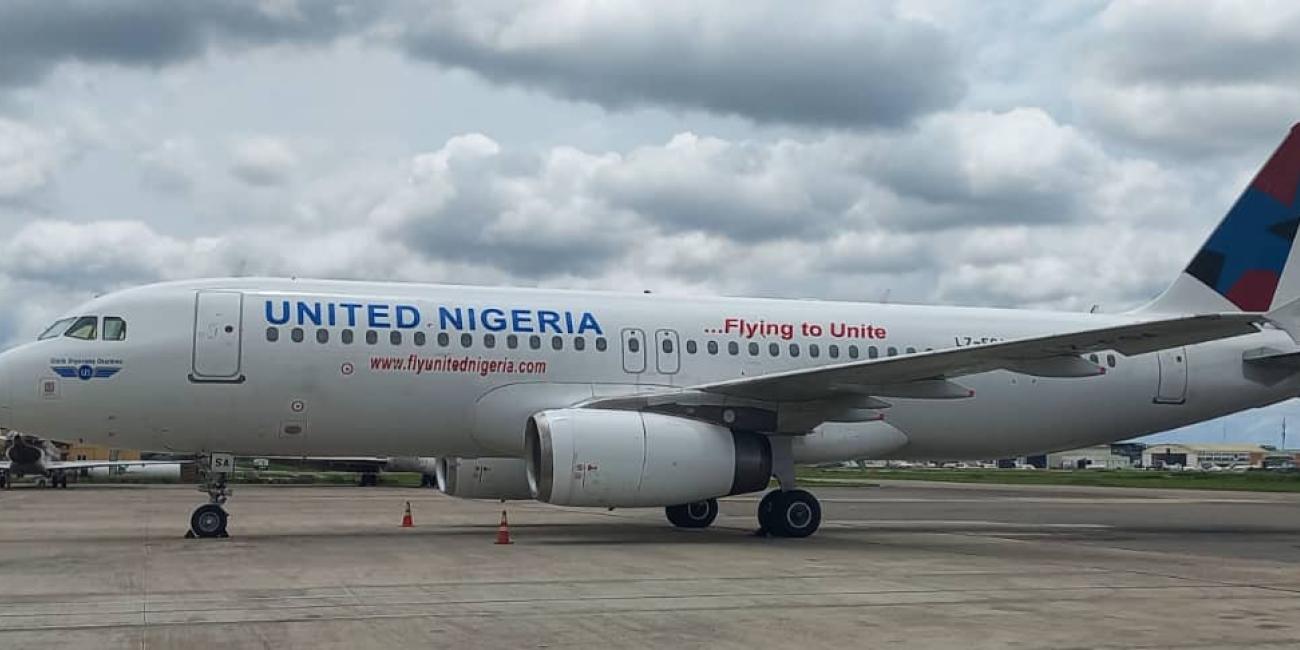
United Nigeria Airlines has confirmed a second bird strike incident involving one of its Airbus aircraft within 24 hours, bringing renewed attention to operational disruptions across its route network and marking the fourth such occurrence since January 2026.
In a statement issued on Sunday, February 15, 2026, and signed by its Public Relations Office, the airline disclosed that the latest incident occurred during the take-off of Flight UN0519 from the Nnamdi Azikiwe International Airport, Abuja, en route to the Murtala Muhammed International Airport, Lagos.
According to the airline, the bird strike affected one of the engines of an Airbus A320 aircraft scheduled to depart at 12:00 hours on Sunday. The airline described the incident as the second bird strike in less than 24 hours and the fourth recorded since the beginning of the year.
“United Nigeria Airlines wishes to inform its valued passengers and the general public of a second bird strike in less than 24-hours, and the fourth since January 2026 — has occurred on one of the engines of another Airbus A320 aircraft during the take-off of Flight UN0519 scheduled for 12:00 hours from Nnamdi Azikiwe International Airport, Abuja, to Murtala Muhammed International Airport, Lagos, on Sunday, 15 February 2026,” the statement read.
The development means that at least two Airbus aircraft in the airline’s fleet have been withdrawn from service within a 24-hour period due to bird strike incidents. This has heightened concerns about potential ripple effects on flight schedules and passenger travel plans across the airline’s network.
United Nigeria Airlines stated that the affected aircraft was immediately grounded in line with established aviation safety protocols. The airline reiterated that passenger safety remains its foremost priority and that no aircraft would return to service without undergoing comprehensive technical inspections.
“In line with our strict and uncompromising safety standards, the affected aircraft has been withdrawn from service for comprehensive technical inspections before returning to operations,” the airline said.
“This brings the total number of Airbus aircraft withdrawn from service in less than 24 hours to TWO (2),” it added.
Bird strikes are a known hazard in aviation, particularly during take-off and landing phases when aircraft operate at lower altitudes and are more likely to encounter bird activity. Such incidents can result in engine damage or, in rare cases, more serious mechanical complications. Aviation authorities worldwide require immediate inspection and, where necessary, grounding of aircraft involved in bird strike incidents to ensure airworthiness and passenger safety.
Although the airline did not provide detailed information on the extent of the engine damage sustained during the latest incident, its decision to withdraw the aircraft from service underscores the precautionary measures mandated under international aviation safety standards.
The airline also acknowledged that the temporary grounding of two Airbus aircraft within such a short timeframe would inevitably disrupt scheduled operations. Passengers travelling on affected routes were advised to anticipate possible delays, rescheduling, or cancellations.
“As a result, some flights across our network will be disrupted and may not operate as earlier scheduled. United Nigeria Airlines remains firmly committed to upholding the highest safety standards,” the statement said.
The recurrence of bird strikes in a short span has raised broader concerns about wildlife hazard management around airports. Airports typically deploy bird control measures such as habitat management, bird dispersal techniques, and radar monitoring systems to reduce the risk of bird-aircraft collisions. However, the effectiveness of such measures can vary depending on environmental factors, seasonal bird migration patterns, and surrounding land use.
United Nigeria Airlines described the latest incident as “another bird strike too many,” reflecting frustration over the frequency of occurrences since the start of the year. The airline expressed regret over the inconvenience caused to passengers and appealed for patience and understanding.
“This is indeed another bird strike too many, however, we sincerely apologise for any inconveniences this unforeseen development may cause to your travel plans and kindly seek the understanding and patience of our valued passengers and the general public,” the statement read.
“Our team is working diligently to minimize disruptions and to provide support to all affected travelers.”
Industry analysts note that when multiple aircraft are grounded simultaneously, airlines may face operational strain, particularly if fleet size is limited. Such disruptions can lead to flight delays cascading across multiple routes, especially on high-traffic corridors such as Abuja–Lagos.
The Abuja–Lagos route is one of the busiest domestic air corridors in Nigeria, with frequent daily departures operated by several carriers. Any reduction in available aircraft capacity on this route can have significant implications for passenger movement, business travel, and cargo operations.
Despite the setbacks, aviation safety experts emphasise that grounding affected aircraft for inspection is a necessary precaution and reflects adherence to global best practices. Engine inspections following bird strikes typically involve detailed examination of fan blades, compressor sections, and other critical components to detect potential structural or mechanical damage.
United Nigeria Airlines has not indicated how long the affected aircraft will remain out of service, stating only that they will undergo “comprehensive technical inspections” before returning to operations.
As of the time of filing this report, there were no indications of injuries to passengers or crew arising from the latest incident. The airline’s communication focused primarily on operational adjustments and safety assurances.
The recurrence of bird strikes within a short period places renewed focus on aviation risk management and coordination between airlines and airport authorities. While bird strikes are generally classified as external environmental hazards beyond direct airline control, the impact on fleet availability and schedule integrity can be substantial.
For passengers, the immediate concern remains potential delays or cancellations. For the airline, the challenge lies in managing operational continuity while maintaining uncompromising safety standards.
United Nigeria Airlines reiterated that it remains committed to ensuring the highest levels of safety and professionalism in its operations. As inspections proceed and recovery plans are implemented, affected passengers are expected to receive further updates regarding their travel arrangements.