Former presidential candidate of the Labour Party, Mr Peter Obi, on Wednesday embarked on an extensive grassroots engagement across several Area Councils in the Federal Capital Territory (FCT), Abuja, reiterating his belief that leadership must be rooted in direct contact with the people and responsive to their everyday realities.
Starting as early as 6:30 a.m., Obi set out from his office in the Abuja Municipal Area Council (AMAC) with what he described as a clear mission to engage directly with communities, listen to their concerns, and reinforce a vision of governance built on service, accessibility, and accountability.
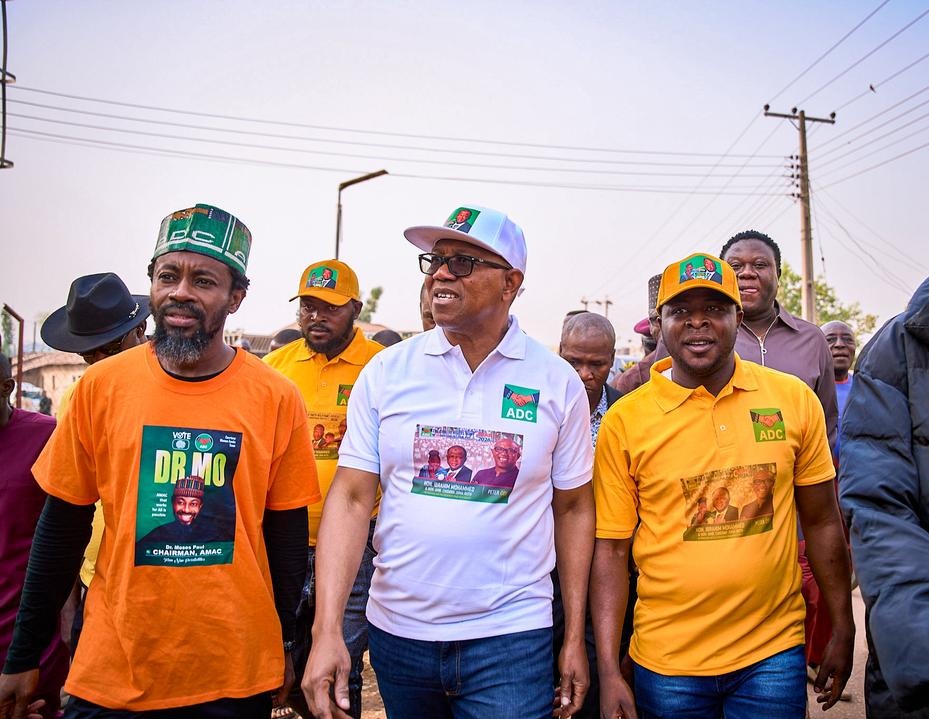
His first stop was Abaji Area Council, where he joined Dr Mohammed Ibrahim, the African Democratic Congress (ADC) chairmanship candidate for the area, in a community walk that lasted over an hour. Obi moved through streets and neighbourhoods, interacting with residents, traders, artisans, and youths, many of whom seized the opportunity to share their challenges and expectations.
According to Obi, the walk was not merely symbolic but a deliberate effort to understand the lived experiences of ordinary citizens. He noted that true leadership cannot be practised from a distance or confined to air-conditioned offices, but must be shaped by constant engagement with the people.
“The essence of leadership is service,” Obi said during the interaction. “And service begins with listening. You cannot genuinely serve the people if you do not understand their daily struggles, hopes, and aspirations.”
Residents of Abaji expressed concerns ranging from poor infrastructure and limited access to healthcare to unemployment and rising cost of living. Obi assured them that responsive governance begins at the grassroots and requires leaders who are willing to walk with the people, both literally and figuratively.
From Abaji, Obi proceeded to Kwali Area Council, where he campaigned alongside Hon. Jeremiah Badoji, the ADC chairmanship candidate. Once again, he undertook a one-hour walk through the community, engaging directly with residents in markets, streets, and public spaces.
Speaking during the Kwali engagement, Obi emphasised that leadership is forged through presence, endurance, and sincerity. He stressed that political leadership should not be an abstract concept reserved for campaign seasons, but a continuous relationship built on trust and shared responsibility.
“Leadership is not about motorcades or distant speeches,” he said. “It is about showing up, standing with the people, and demonstrating, through action, that their welfare matters.”
Obi’s next stop was Zuba, in Gwagwalada Area Council, where he rallied support for Pharmacist Iko Danjuma, the ADC chairmanship candidate. The visit attracted a large crowd of supporters and residents, who welcomed Obi with chants and expressions of solidarity.
In Zuba, Obi reiterated his commitment to a development agenda that prioritises education, healthcare, security, and economic opportunity. He noted that meaningful progress at the national level is impossible without strong, people-oriented leadership at the local government level.
“Local councils are the closest tier of government to the people,” Obi said. “If we get leadership right at this level, it becomes easier to drive sustainable development across the state and the nation.”
The grassroots tour continued to Dei-Dei Market, one of the largest commercial hubs in Abuja, where Obi engaged directly with traders, transport workers, and residents. At the market, he campaigned for Dr Moses Paul, the ADC chairmanship candidate for Abuja Municipal Area Council (AMAC).
Walking through the bustling market, Obi listened to traders who complained about multiple taxation, insecurity, poor market infrastructure, and inadequate access to credit. He assured them that inclusive development must cut across all sectors of society, particularly small and medium-scale enterprises, which he described as the backbone of the economy.

“Our traders and small business owners are not asking for handouts,” Obi said. “They are asking for a fair environment where they can thrive. Government must create that environment by investing in infrastructure, ensuring security, and eliminating policies that stifle productivity.”
Throughout the day’s engagements, Obi maintained a consistent message: that Nigeria’s challenges can only be addressed through honest leadership, prudent management of resources, and active citizen participation. He urged residents to remain engaged in the political process and to support candidates who demonstrate integrity, competence, and empathy.
Obi also used the opportunity to restate his long-held belief that a new Nigeria is achievable through collective effort and responsible leadership. He emphasised that change does not begin at the top alone but is driven by informed citizens and credible leaders at all levels of governance.
“A New Nigeria is not just a slogan,” he said. “It is a possibility that depends on the choices we make today—especially at the grassroots. When people come together to demand accountability and support the right leaders, transformation becomes inevitable.”
Supporters who accompanied Obi on the tour described the exercise as refreshing and inspiring, noting that his willingness to walk long distances and engage directly with ordinary people reflected the leadership style he advocates.
As the day-long grassroots outreach concluded, Obi expressed gratitude to residents across Abaji, Kwali, Gwagwalada, and AMAC for their warm reception and candid conversations. He reaffirmed his commitment to people-centred governance and called on Nigerians to remain hopeful, engaged, and resolute in the pursuit of a more just, prosperous, and inclusive nation.
In his closing message, Obi reiterated his signature refrain, underscoring the optimism that continues to define his political engagement: “A New Nigeria is not just a dream; it is a possibility.”