The Federal Government has reaffirmed its commitment to protecting all Nigerians irrespective of religious affiliation, declaring that any act of violence framed along religious lines will be treated as a direct attack on the Nigerian state.
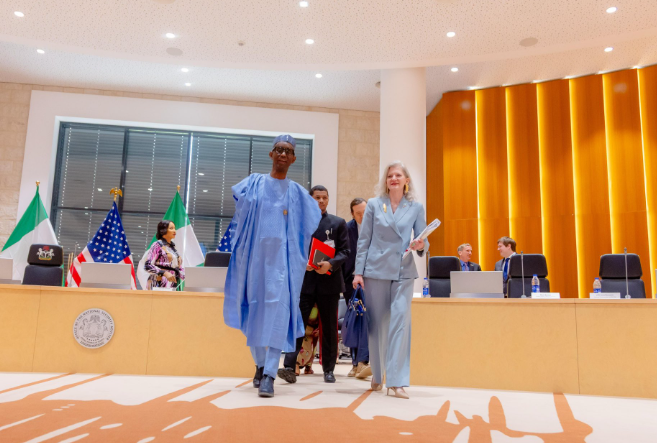
National Security Adviser (NSA), Mallam Nuhu Ribadu, made the position clear in Abuja at the close of a United States–Nigeria Joint Working Group meeting on security and religious freedom, according to a statement issued by presidential spokesperson, Bayo Onanuga.
Ribadu stressed that Nigeria’s plural and multi-religious character makes the protection of all citizens a fundamental obligation of the state, warning that the government would not tolerate attempts to exploit religion as a tool for violence or division.
Related posts:
- Against Dangerous Labels: Nigerian Scholar Warns Against Mischaracterising Insecurity as Religious Genocide
- Holiday Security – IPOB’s Assurances Raise Critical Questions About State Authority and Public Confidence in the Southeast
- (Video) 24 Abducted Kebbi Schoolgirls Regain Freedom Amid Rising Security Concerns in Northern Nigeria
- FOSAD Urges Southeast Governors to Emulate Southwest Security model and Establish a Joint Regional Security Fund
“Nigeria is a deeply plural society, and the protection of all citizens, Christians, Muslims, and those of other beliefs, is non-negotiable,” Ribadu said.
“Violence framed along religious lines is treated as an attack on the Nigerian state itself.”
The remarks come amid sustained international attention on Nigeria’s security challenges, particularly concerns over sectarian violence, terrorism, and attacks on religious communities in parts of the country.
In a follow-up post on X, Ribadu said the US–Nigeria Joint Working Group had already recorded what he described as “tangible operational gains” in the fight against terrorism and violent extremism.
The Joint Working Group was established following Nigeria’s designation as a Country of Particular Concern (CPC) by United States President Donald Trump. The CPC designation is typically applied to countries accused of engaging in or tolerating severe violations of religious freedom and often leads to heightened diplomatic engagement and policy measures aimed at addressing the underlying issues.
At the Abuja meeting, Ribadu led Nigeria’s delegation, which comprised representatives from 10 key ministries, departments and agencies involved in security, justice, foreign affairs and humanitarian response. The United States delegation, drawn from eight federal agencies, was led by Allison Hooker, the US Under-Secretary of State.
Ribadu said the engagement marked a shift in Nigeria–US security cooperation from rhetoric to concrete action, noting that the partnership had produced measurable results in disrupting terrorist cells and transnational criminal networks operating within and beyond Nigeria’s borders.
According to the NSA, sustained collaboration with the United States has enhanced Nigeria’s operational capacity, particularly through the provision of critical security assets.
He praised the US government for supplying drones, helicopters, platforms, spare parts and other support systems over the past five years, describing the assistance as instrumental in strengthening Nigeria’s counter-terrorism and surveillance capabilities.
“Our cooperation has moved beyond dialogue to action,” Ribadu said, adding that joint efforts have helped degrade the operational reach of terrorist organisations and improve intelligence sharing between both countries.
He maintained that the Nigerian government remains committed to tackling insecurity in all its forms, including insurgency, banditry, kidnapping and communal violence, while ensuring that security responses are guided by the rule of law and respect for human rights.
Speaking at the session, US Under-Secretary of State Allison Hooker reaffirmed Washington’s commitment to deepening its partnership with Nigeria, particularly in addressing violence targeting Christian communities.
“Today, we are here to discuss how we can work together to deter violence against Christian communities, prioritising counter-terrorism, insecurity, investigation of attacks, and holding perpetrators accountable,” Hooker said.
She noted that the US was keen to support Nigeria in strengthening accountability mechanisms and improving the investigation and prosecution of those responsible for religiously motivated violence.
Hooker added that future efforts would focus on reducing killings, forced displacement and abductions of Christians, especially in Nigeria’s north-central states, which have experienced repeated attacks linked to communal and sectarian tensions.
The US official also underscored the importance of protecting freedom of religion and belief as a cornerstone of democratic governance, stressing that long-term stability depends on addressing grievances, promoting justice and ensuring inclusive security policies.
Observers say the Joint Working Group reflects growing US concern over Nigeria’s security situation, particularly following reports by international rights groups highlighting attacks on religious communities and the humanitarian impact of violence.
However, Nigerian officials have repeatedly argued that insecurity in the country is driven more by criminality, terrorism and competition over resources than by state-sponsored or tolerated religious persecution.
Ribadu reiterated this position, emphasising that the Nigerian government does not tolerate violence against any religious group and remains resolute in its duty to protect all citizens.
He said the government would continue to engage international partners while strengthening domestic institutions to address the root causes of violence, improve early warning systems and enhance rapid response capabilities.
The NSA also called for sustained international support, noting that Nigeria’s security challenges have regional and global implications, given the transnational nature of terrorism and organised crime in West Africa.
As the Joint Working Group concludes its latest session, both Nigeria and the United States expressed optimism that continued cooperation would yield further gains in curbing violence, improving security and upholding religious freedom across the country.
The Federal Government said it remains focused on restoring peace, rebuilding trust among communities and ensuring that no Nigerian is targeted or marginalised because of faith or belief.