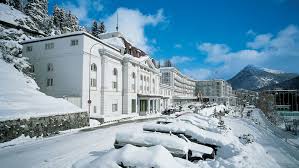
United States President Donald Trump arrived in Davos on Wednesday for what is shaping up to be one of the most consequential confrontations between Washington and its European allies in decades, as his renewed push to acquire Greenland threatens to fracture the transatlantic alliance.
Trump’s appearance at the World Economic Forum came amid heightened tensions with European leaders who have closed ranks against his increasingly aggressive posture toward Denmark, a fellow NATO member that exercises sovereignty over the autonomous Arctic territory. The dispute has dominated discussions at the Swiss alpine resort, overshadowing broader debates on global economic stability, security and governance.
The US president’s journey to Davos was itself marked by disruption. His arrival was delayed after a “minor electrical issue” forced Air Force One to turn back shortly after takeoff, necessitating a change of aircraft. As a result, Trump arrived several hours later than scheduled and postponed his planned address to the annual gathering of political and business elites.
Related posts:
- Trump Insists U.S. Control of Greenland is Non-Negotiable, Escalating Tensions With Denmark and Allies
- Tinubu Government Approves $9 Million Lobbying Deal With Republican Firm Amid Rising Tensions With Trump Administration
- French Prime Minister resigns after less than a month in office, deepening political turmoil
- Shettima Unveils Nigeria House at Davos, Signals Renewed Global Economic Engagement
Even before setting foot in Davos, Trump had intensified his rhetoric, mocking European leaders over their resistance to his Greenland ambitions. His remarks prompted a coordinated response from senior European figures, including French President Emmanuel Macron and European Commission President Ursula von der Leyen, who warned that the dispute could fundamentally alter relations between the United States and Europe.
At Davos on Tuesday, Macron adopted a defiant tone, vowing to stand against what he described as attempts by Washington to “subordinate Europe.” He criticised Trump’s threats to impose sweeping tariffs on European countries backing Denmark, calling such measures “unacceptable” and dangerous to global economic stability. France subsequently announced it was calling for a NATO military exercise in Greenland and said it was ready to contribute, a move widely seen as a signal of European resolve.
European unity was further reinforced by Canadian Prime Minister Mark Carney, who received a standing ovation at the Forum after delivering a stark assessment of the state of the US-led global order. Carney warned that the world was witnessing a fundamental break rather than a gradual evolution. “We are in the midst of a rupture, not a transition,” he said, arguing that major powers were increasingly using economic integration as a tool of coercion rather than cooperation.
The coordinated European stance drew a sharp rebuke from the US Treasury Secretary, Scott Bessent, who urged leaders to temper their reactions and await Trump’s direct engagement. Speaking to reporters in Davos hours before the president’s arrival, Bessent cautioned against what he called reflexive anger and bitterness. He encouraged European leaders to listen to Trump’s case for Greenland, suggesting that dialogue could ease tensions.
Trump himself showed little inclination to soften his approach. He confirmed that he would hold several meetings on Greenland during the Forum and hinted at further escalation when asked how far he was prepared to go to secure the territory from Denmark. “You’ll find out,” he told reporters, adding to the uncertainty surrounding his intentions. As he departed the White House, Trump admitted he had “no idea” how the Davos trip would unfold.
At the heart of the dispute is Trump’s insistence that mineral rich Greenland is strategically vital to US and NATO security, particularly as climate change accelerates Arctic ice melt and opens new shipping routes and access to natural resources. Trump argues that increased competition from Russia and China in the region makes US control or influence over Greenland essential to Western security interests.
To pressure European governments into backing his position, Trump has threatened tariffs of up to 25 percent on eight European countries that have publicly supported Denmark. The move has raised fears of a transatlantic trade war at a time when global growth remains fragile. European officials have responded by warning of countermeasures, with some leaders speaking openly about deploying powerful trade instruments against Washington.
Trump dismissed such threats, telling a US television network that any European action against the United States would backfire. “Anything they do with us, all I have to do is meet it and it’s going to go ricocheting backward,” he said, while adding that he still believed a negotiated solution could emerge, possibly even during the Davos meetings.
European Commission President Ursula von der Leyen warned that Trump’s approach risked pushing relations between Washington and Brussels into a “downward spiral.” She cautioned that escalating trade disputes and unilateral security demands could undermine decades of cooperation built on shared values and mutual trust.
The controversy has also alarmed leaders in Greenland itself. The island’s prime minister said on Tuesday that Greenland’s small population of about 57,000 people must be prepared for all scenarios, including the possibility of military force. The comments underscored the anxiety gripping the territory as it finds itself at the centre of a geopolitical struggle among global powers.
Despite the focus on Greenland, the White House said Trump’s Davos address would primarily emphasise domestic economic issues, particularly the cost of living crisis confronting American households. With the 2026 midterm elections looming, the administration is keen to reassure voters that economic growth and inflation remain top priorities.
Nevertheless, Trump’s assertive foreign policy stance, now one year into his second term, has ensured that Greenland will form the backdrop to his speech. Observers say his remarks will be closely scrutinised for signals of whether he intends to de-escalate tensions or double down on his confrontational approach.
Adding another layer of intrigue to the Davos gathering, Trump is expected on Thursday to formally announce the first charter of his proposed “Board of Peace,” an international body designed to resolve global conflicts. The initiative carries a reported one billion dollar price tag for permanent membership and was initially conceived as a mechanism to oversee the rebuilding of Gaza. However, a draft of the charter seen by AFP suggests its mandate may extend far beyond the occupied Palestinian territory.
As Trump engages European leaders behind closed doors, diplomats and analysts are watching closely to see whether Davos becomes a turning point or a breaking point for the transatlantic alliance. The outcome of the Greenland dispute, and the broader tone set by Trump’s interactions, could have lasting implications for global security, trade and governance in an increasingly multipolar world.
AFP