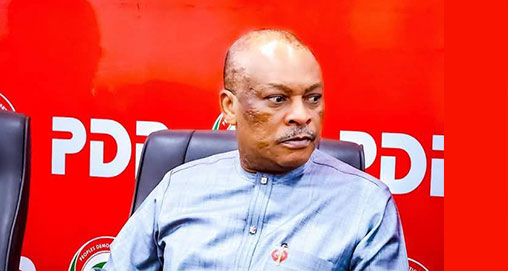
The Federal High Court sitting in Abuja has dismissed a suit filed by Senator Samuel Anyanwu seeking judicial affirmation of his position as the National Secretary of the Peoples Democratic Party (PDP), ruling that the matter falls within the internal affairs of the party and that his legal tenure has elapsed.
In a judgment delivered on Tuesday, January 13, 2026, Justice M. G. Umar struck out the suit marked FHC/ABJ/CS/254/2025, describing it as an abuse of court process and a re-litigation of issues that have already been conclusively determined by superior courts. The ruling represents a major setback for Anyanwu, who has been locked in a prolonged legal and political struggle over his status within the PDP’s National Working Committee (NWC).
Justice Umar held that the judiciary lacks the constitutional authority to interfere in how political parties conduct their internal leadership affairs, including appointments, tenure, and transitions within party structures. The court relied heavily on settled Supreme Court precedents which consistently affirm that courts must refrain from adjudicating on disputes that are purely internal to political parties.
Related posts:
“The issues brought before this court are clearly matters bordering on the internal administration of a political party,” Justice Umar ruled. “It is trite law that courts are barred from dabbling into such matters, except where there is a clear violation of statutory or constitutional provisions.”
The judge further ruled that Anyanwu’s suit amounted to an abuse of court process, noting that similar claims had been pursued by the claimant at different levels of the judiciary, including the Court of Appeal and the Supreme Court.
According to the court, allowing the suit to proceed would amount to encouraging endless litigation over an issue that has already been sufficiently ventilated and resolved through established judicial channels.
A key pillar of the judgment was the issue of tenure. Justice Umar held that Anyanwu’s four-year tenure as National Secretary, which began following his election in 2021, had legally expired. The court found no basis in law for Anyanwu’s continued claim to the office beyond the expiration of that term, particularly after the PDP held a fresh national convention that produced a new leadership.
“The claimant was elected in 2021 for a four-year term. That tenure has run its full course. There is no provision of law that allows him to remain in office beyond that period,” the judge stated.
The ruling comes against the backdrop of the PDP’s National Convention held in Ibadan, Oyo State, in November 2025, a watershed event that reshaped the party’s leadership structure. At the convention, delegates elected a new National Working Committee, with former Minister of Special Duties, Kabiru Tanimu Turaki, SAN, emerging as the party’s National Chairman.
The Ibadan convention also took far-reaching disciplinary actions against some party members, including Senator Anyanwu, who was accused of engaging in anti-party activities. Following those decisions, Anyanwu had approached the court seeking injunctive reliefs, including an order restraining the Independent National Electoral Commission (INEC) from recognizing any PDP correspondence not signed by him as National Secretary.
Justice Umar’s ruling effectively extinguished those claims, holding that once a party has conducted a valid convention and produced new officers, the courts have no power to impose a different leadership arrangement on it.
“The court cannot compel INEC or any other body to recognize an officer whose tenure has expired and who has been replaced through a valid party process,” the judge ruled.
The legal battle over the PDP National Secretary position has its roots in events dating back to 2023, when Senator Anyanwu stepped aside from his party role to contest the Imo State governorship election. Following his defeat and subsequent attempt to return to office, internal disagreements erupted within the PDP, with a faction of the party nominating Sunday Udeh-Okoye as his replacement.
The dispute soon escalated into a complex legal tussle involving multiple court cases and conflicting judgments. In March 2025, the Supreme Court delivered a ruling that temporarily favoured Anyanwu, reinstating him on jurisdictional grounds. However, that judgment did not expressly affirm his continued tenure beyond the lifespan of the 2021 mandate.
Legal analysts have since noted that the Supreme Court’s decision was limited in scope and did not prevent the party from conducting a fresh convention or reorganizing its leadership structures in line with its constitution.
The November 2025 Ibadan convention, therefore, marked a decisive turning point. By electing a new National Working Committee, the PDP effectively reset its leadership, a move the Federal High Court has now declined to question or reverse.
Justice Umar stressed that political parties are voluntary associations governed by their constitutions and internal rules, and that members who submit themselves to party processes must abide by the outcomes, whether favourable or not.
“Once a political party conducts its convention in accordance with its constitution, members are bound by the decisions taken there,” the judge said. “The court will not sit as a supervisor over internal party democracy.”
With the dismissal of Anyanwu’s suit, the Kabiru Tanimu Turaki-led National Working Committee remains the recognized administrative and executive authority of the PDP. INEC is also legally free to continue recognizing the current leadership without fear of contempt or judicial contradiction.
As of the time of filing this report, Senator Anyanwu had not issued an official statement indicating whether he intends to appeal the decision. However, sources close to the former National Secretary said consultations were ongoing within his legal and political circles on the next steps.
The ruling has elicited varied reactions within the PDP. Supporters of the current leadership have hailed the judgment as a victory for internal democracy and party stability, arguing that endless litigation has distracted the party from its core responsibility of rebuilding ahead of future elections.
“This judgment gives the PDP a clean slate to move forward,” a senior party official said. “We cannot continue to fight ourselves in court while the country expects us to provide credible opposition.”
Conversely, some allies of Anyanwu described the ruling as politically motivated, insisting that his removal was part of a broader internal power struggle within the party. They argue that his initial stepping aside to contest the governorship election should not have automatically terminated his mandate.
Despite these differing views, legal experts say the judgment reinforces a long-standing judicial philosophy in Nigeria that courts should not be used as battlegrounds for internal party supremacy.
“The decision aligns with established jurisprudence,” a constitutional lawyer told reporters. “Political parties must resolve their internal disputes through their own mechanisms. The courts have drawn that line very clearly.”
As the PDP prepares for future electoral contests, the resolution of the National Secretary dispute may offer a measure of institutional clarity, even as underlying political tensions within the party continue to simmer.
For now, the Federal High Court’s ruling stands as a definitive legal pronouncement on the matter, closing yet another chapter in one of the PDP’s most protracted internal crises.