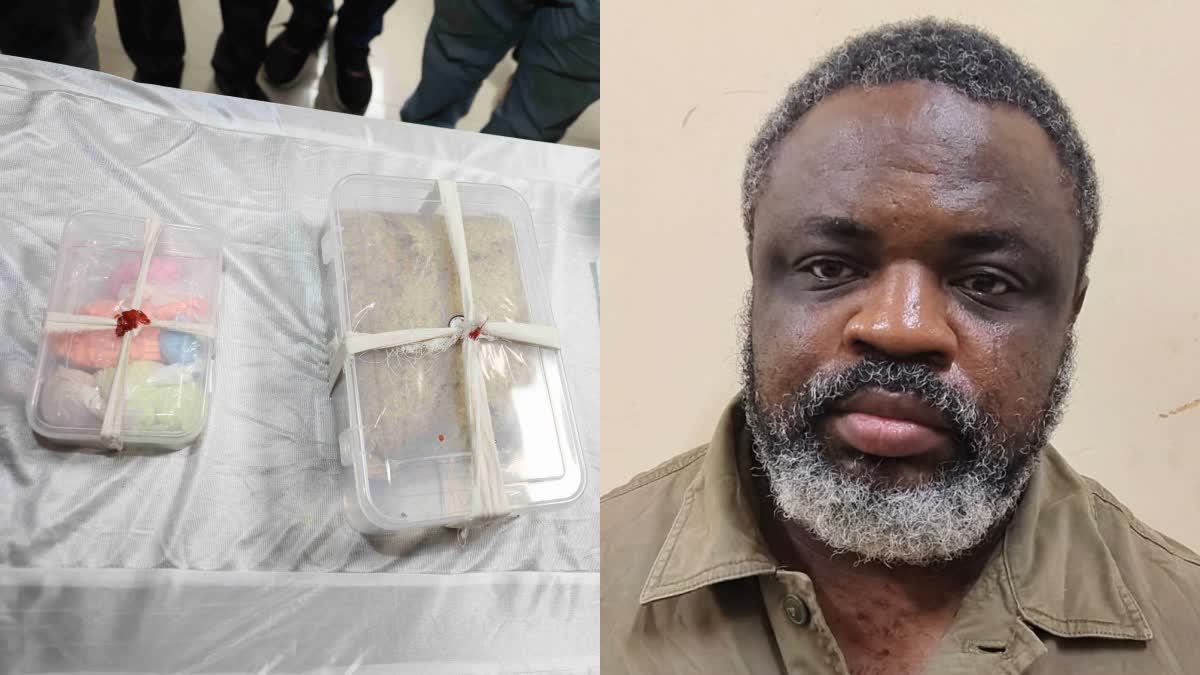
The Anti-Narcotics Wing of the Central Crime Branch (CCB) of the Bengaluru City Police has dismantled a major drug peddling operation with the arrest of a Nigerian national, Ernest Onyekachi Ugah, after recovering large quantities of synthetic drugs valued at more than ₦800 million in the international market.
Ugah, 45, was arrested on the night of Monday, January 19, 2026, following intelligence-led operations by the Anti-Narcotics Wing, which had reportedly been monitoring his activities for weeks. The arrest was carried out in the Munnekolalu area, which falls under the jurisdiction of the Marathahalli Police Station in Bengaluru.
According to police officials, a total of 2.5 kilograms of Methylenedioxymethamphetamine (MDMA), commonly known as “ecstasy” or “molly,” and 300 ecstasy pills were recovered from the suspect’s possession. The seized narcotics are estimated to be worth approximately Rs 5.15 crore on the international market, translating to over ₦800 million.
Confirming the arrest on Tuesday, officers of the Central Crime Branch described the operation as a significant breakthrough in the fight against the growing menace of synthetic drug trafficking in Bengaluru and other parts of India.
“The Anti-Narcotics Wing, acting on credible intelligence, conducted a targeted operation and apprehended the accused while he was actively engaged in peddling narcotic substances,” a senior police official said.
Investigations revealed that Ugah had been operating from a rented apartment in Munnekolalu, using the location as a base to distribute narcotics across different parts of the city. Police sources said the suspect allegedly supplied MDMA and ecstasy pills to a network of local dealers, party organisers, and users, particularly within the city’s nightlife and entertainment circles.
Further checks by the police uncovered that Ugah is not a first-time offender. He reportedly has two previous cases registered against him under India’s Narcotic Drugs and Psychotropic Substances (NDPS) Act. The earlier cases were filed at the Hennur Police Station and the Kadugodi Police Station, both in Bengaluru.
Police disclosed that the suspect had only recently been released from prison after serving time in connection with earlier drug-related offences. His release, officers said, prompted renewed surveillance by the Anti-Narcotics Wing, which ultimately led to his latest arrest.
“He is a repeat offender. After his release from jail, our officers maintained close surveillance on his movements. Based on fresh intelligence, we acted swiftly and arrested him with a substantial quantity of narcotics,” the official said.
Preliminary investigations also revealed that Ugah originally entered India around five years ago, ostensibly for medical treatment. However, authorities said he overstayed his visa and continued to reside illegally in the country long after its expiration.
“The accused had come to the city around five years ago for medical reasons, but he overstayed and became deeply involved in unlawful activities. His visa expired, yet he continued to stay in India and was repeatedly found engaging in criminal acts,” a police officer familiar with the case stated.
Authorities said his continued presence in the country despite an expired visa raises serious concerns about immigration monitoring and enforcement, particularly in cases involving foreign nationals with criminal records.
Following the arrest, a fresh case has been registered against Ugah under relevant sections of the NDPS Act. He is currently in police custody, and further investigations are ongoing to dismantle the wider drug network linked to the seized contraband.
Police said they are working to trace both the backward and forward linkages of the drug supply chain. This includes identifying the source of the MDMA and ecstasy pills, determining how the drugs were smuggled into India, and uncovering other individuals involved in the distribution network.
“We are investigating the entire chain — from procurement to distribution. Our focus is to identify suppliers, local collaborators, financiers, and end distributors who are part of this organised network,” the police said.
Officers added that the recovered narcotics point to a highly structured and well-funded operation, suggesting possible international connections beyond India’s borders.
The arrest has once again brought renewed attention to the challenges faced by Indian law enforcement agencies in curbing synthetic drug trafficking, particularly involving foreign nationals who repeatedly exploit legal loopholes and delays in the judicial process.
Police officials stressed the urgent need for fast-track trials in cases involving repeat offenders and foreign nationals arrested for drug-related crimes. According to them, prolonged court proceedings often allow accused persons to secure bail and return to criminal activities.
“If fast-track trials are conducted, such accused can be convicted and deported to their home countries at the earliest,” an officer said. “In the absence of fast-track proceedings, they continue to get bail and resume the same offences.”
The officer further argued that bail conditions for drug-related offences, especially for repeat offenders, need to be made significantly more stringent to deter recidivism.
“Drug trafficking is a serious crime that destroys lives and communities. When repeat offenders are easily granted bail, it undermines the efforts of law enforcement agencies and emboldens criminal networks,” the officer added.
MDMA and ecstasy pills are among the most commonly abused synthetic drugs, particularly within urban centres. Law enforcement agencies in India have repeatedly warned that the trafficking and consumption of such substances have increased in recent years, driven by demand from party scenes, clubs, and youth subcultures.
Bengaluru, being a major metropolitan city with a large youth population and vibrant nightlife, has emerged as a hotspot for synthetic drug distribution, prompting intensified operations by the Anti-Narcotics Wing and other security agencies.
The latest arrest underscores the continued resolve of the Bengaluru City Police to crack down on drug trafficking networks and prevent the city from becoming a hub for synthetic narcotics.
“This operation sends a strong message that we will not tolerate drug peddling, irrespective of the nationality of those involved,” the police said.
As investigations continue, authorities are expected to collaborate with immigration officials and possibly foreign law enforcement agencies to determine the full extent of Ugah’s operations and to ensure that appropriate legal and administrative actions, including deportation after prosecution, are pursued.
The case has also reignited public debate on border control, visa enforcement, and the need for closer international cooperation in tackling transnational drug trafficking syndicates.
Police have assured the public that further arrests may follow as the investigation progresses, urging residents to report suspicious activities and cooperate with law enforcement agencies in the fight against narcotics.