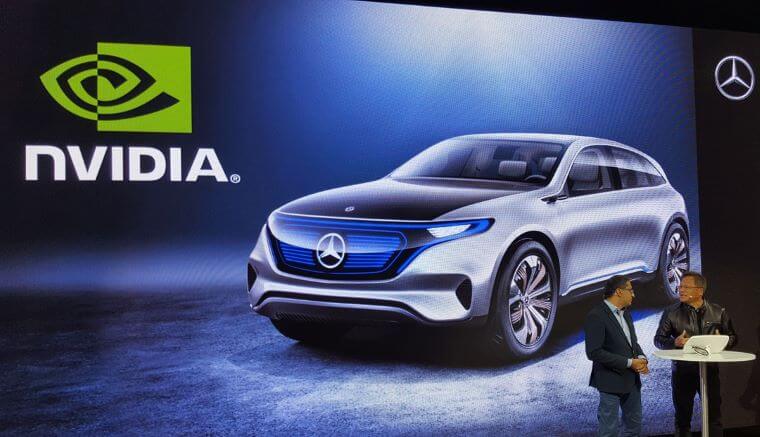
Nvidia Chief Executive Officer Jensen Huang delivered a major surprise at the Consumer Electronics Show (CES) 2026 in Las Vegas, announcing that the company’s first fully AI-driven autonomous vehicle, developed in partnership with Mercedes-Benz, will begin operating on public roads in the first quarter of this year.
The announcement, made during Huang’s keynote address on January 5, marked a significant milestone in the global race toward fully autonomous transportation. According to the Nvidia CEO, the breakthrough is powered by Alpamayo, a new family of open-source artificial intelligence models described as the world’s first “thinking and reasoning” autonomous vehicle AI.
Huang revealed that Alpamayo will debut in the upcoming Mercedes-Benz CLA, representing the culmination of a five-year collaboration between the Silicon Valley chipmaker and the German luxury automaker. While Mercedes-Benz handled the physical development of the vehicle, including exterior styling, interior systems, and hardware integration, Nvidia provided the complete autonomous driving software stack.
Related posts:
- Police to commence enforcement of motor vehicle tinted glass law from October 2nd
- Kemi Badenoch Unveils “Radical Borders Plan”: ‘If You’re in the UK Illegally, You Will Be Detained and Deported’
- INEC Engages PDP Leadership Over Internal Crisis Ahead of 2026 Elections
- APC Releases Timetable for Nationwide Congresses, Sets March 2026 National Convention
“Alpamayo is trained end to end, literally from camera in and actuation out,” Huang said during his presentation. “It reasons about the action it is about to take, the reasoning behind that action, and the trajectory.”
He explained that unlike earlier generations of autonomous driving systems that relied heavily on predefined rules or narrow machine learning models, Alpamayo is designed to reason in real time. This allows the vehicle to interpret its surroundings, evaluate multiple possible actions, and choose the safest and most efficient response, even in complex and unpredictable driving environments.
To demonstrate the technology’s capabilities, Huang played a video showing a Mercedes-Benz CLA navigating real-world driving scenarios autonomously. The footage highlighted the vehicle’s ability to respond smoothly to traffic conditions, pedestrians, and changing road layouts, underscoring Nvidia’s claim that Alpamayo represents a major leap forward in autonomous driving intelligence.
According to Nvidia, the Mercedes-Benz CLA equipped with Alpamayo is scheduled for a phased global rollout. The model is expected to launch in the United States in the first quarter of 2026, followed by Europe in the second quarter. Releases in Asia are planned for the third and fourth quarters of the year.
Beyond powering a single vehicle model, Alpamayo is positioned as a broader autonomous driving platform. Nvidia said it introduces vision-language-action, or VLA, models that allow self-driving systems to combine visual perception with language-based reasoning and precise physical action. This enables vehicles not only to “see” their environment, but also to understand context, reason through complex situations, and execute highly accurate driving maneuvers.
The platform also incorporates large reasoning models, advanced simulation tools, and open datasets designed to test rare, dangerous, or edge-case scenarios that are difficult to encounter in real-world driving. These capabilities, Nvidia said, are essential for improving safety, validating performance, and accelerating progress toward higher levels of vehicle autonomy.
In a statement accompanying the announcement, Nvidia said Alpamayo “enhances transparency, safety, and robustness in autonomous systems, particularly in complex, real-world environments, and supports progress toward higher levels of vehicle autonomy.”
Huang emphasised that while Nvidia builds the full autonomous driving stack, the company’s strategy is rooted in openness and ecosystem collaboration.
“We build the entire stack, but the entire stack is open for the ecosystem,” he said. “The ecosystem working with us to build Level 4 autonomy and robotaxi services is expanding, and it’s going everywhere.”
Level 4 autonomy refers to vehicles capable of performing all driving tasks within specific conditions without human intervention. Huang suggested that such systems could fundamentally reshape personal mobility and urban transportation.
“We imagine that, someday, a billion cars on the road will all be autonomous,” he said. “You could either have it be a robotaxi that you’re orchestrating and renting from somebody, or you could own it.”
The announcement has drawn significant attention from across the automotive and technology industries, with analysts viewing the Nvidia–Mercedes partnership as a powerful combination of cutting-edge AI and established automotive engineering. It also reinforces Nvidia’s growing influence beyond chips and data centers into mobility, robotics, and real-world AI applications.
Meanwhile, questions remain about how other major automakers will respond. When asked whether Hyundai Motor Group plans to apply Nvidia’s Alpamayo platform to its own autonomous vehicle development, Vice Chairman Chang Jae-hoon declined to make direct commitments but left the door open to future collaboration.
Chang noted that Hyundai would discuss any partnerships at a later date, stressing that the company’s broader strategy focuses on building an integrated robotics and autonomous ecosystem rather than isolated products.
“What matters is not just developing a single robot or autonomous system, but how much further we can go,” Chang said. “We aim to combine innovation across our manufacturing operations via a fully built robotics ecosystem, grounded in Hyundai Motor Group’s strengths in safety, quality, and reliability. Once partnerships are finalised, we will disclose and discuss them.”
Hyundai has already deepened its relationship with Nvidia. Late last year, the automaker announced plans to source 50,000 of Nvidia’s Blackwell chips, which are expected to be deployed across Hyundai’s autonomous driving and robotics businesses. The move underscores Nvidia’s growing role as a foundational technology provider for next-generation mobility.
In another major announcement on Monday, Nvidia disclosed that its next-generation AI chip, known as Vera Rubin, has entered mass production. The company said the chip is scheduled for an official release in the second half of 2026.
The Vera Rubin chip is expected to further boost Nvidia’s AI computing capabilities, supporting increasingly complex models like Alpamayo and enabling faster, more energy-efficient processing across autonomous vehicles, robotics, and large-scale AI systems.
Taken together, Nvidia’s announcements at CES 2026 signal a decisive push toward an AI-driven future where autonomous systems move beyond controlled environments and into everyday life. With Alpamayo set to hit public roads in partnership with Mercedes-Benz, the company appears poised to play a central role in shaping the next era of transportation, where cars do not just drive, but think, reason, and decide.