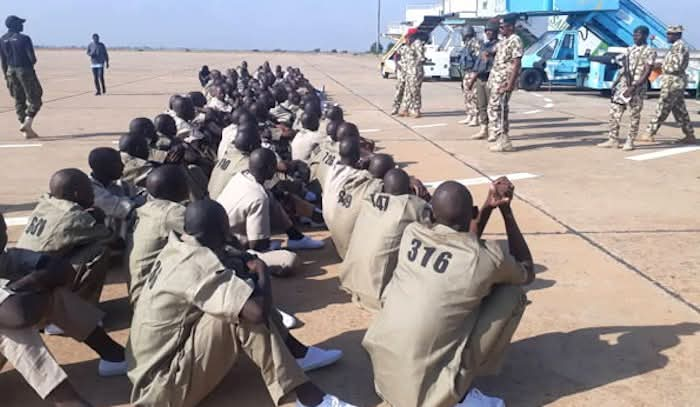
One hundred and seventeen repentant terrorists from Borno State have completed the Disarmament, Rehabilitation and Reintegration (DRR) programme under Operation Safe Corridor, marking another milestone in Nigeria’s non-kinetic approach to counter-insurgency and post-conflict stabilisation. The development was disclosed on Thursday, February 19, 2026, by the Director of Defence Information, Major General Samaila Uba, in a statement issued following a high-level stakeholders’ meeting convened by Defence Headquarters.
The meeting, held at the Nigerian Army Resource Centre, focused on finalising modalities for the transfer of rehabilitated clients to relevant national and state authorities for reintegration into their communities. According to the statement, the graduation of the 117 individuals underscores ongoing efforts to harmonise federal and state mechanisms for the reception, monitoring and long-term reintegration of former combatants who have renounced violent extremism.
The Coordinator of Operation Safe Corridor, Brigadier General Y. Ali, informed participants that the 117 graduates completed the DRR process at the Mallam Sidi Camp in Borno State. He described the outcome as evidence of strengthened coordination between federal and state governments, particularly in ensuring that rehabilitated individuals are properly received, monitored and supported upon return to civilian life. The structured approach, he noted, is designed to reduce recidivism risks and consolidate security gains achieved through sustained military operations.
General Ali emphasised that the successful completion of the programme by the Borno State clients reflects improved institutional collaboration and a more streamlined framework for reintegration. The process at Mallam Sidi Camp includes disarmament procedures, deradicalisation counselling, vocational training, civic education and psychosocial support. These components are intended to address both ideological drivers of extremism and the socio-economic vulnerabilities that often fuel recruitment into insurgent groups.
Beyond the North East, Operation Safe Corridor has been expanded to other regions grappling with insurgency and banditry. General Ali highlighted the extension of the programme to the North West, where a DRR camp established in February last year has been described as a significant stabilisation milestone. The facility was set up in response to the growing need for structured rehabilitation pathways for individuals disengaging from armed groups in that region.
Ongoing engagements with Zamfara State authorities are aimed at recalibrating the North West facility into a more comprehensive Victim Healing, Rehabilitation and Reintegration framework. According to Defence Headquarters, this expanded model integrates psychosocial recovery, community reconciliation initiatives, livelihood support programmes and structured post-reintegration monitoring. The goal is to create a holistic platform that not only addresses the needs of former fighters but also supports affected communities in rebuilding trust and social cohesion.
In the North Central region, Brigadier General Ali disclosed that Benue State has formally requested the establishment of a DRR camp to support its stabilisation efforts. Defence Headquarters has since conducted assessments of proposed sites and advised that any approval would require strict alignment with national standards on infrastructure, security and long-term sustainability. The careful evaluation process reflects lessons learned from earlier phases of the programme, where logistical and community acceptance challenges required adaptive responses.
The stakeholders’ meeting drew a broad spectrum of participants, reflecting the multi-dimensional nature of Nigeria’s counter-insurgency strategy. Representatives from federal ministries, the Office of the National Security Adviser and various state governments were in attendance. Delegations from neighbouring countries—Burkina Faso, Chad, Niger and Cameroon—also participated, highlighting the transnational dimensions of insurgency in the Lake Chad Basin and the importance of regional cooperation.
International partners were represented as well, including the International Committee of the Red Cross and the International Organization for Migration. Observers from Norway, the United Kingdom, the European Union and the Foreign, Commonwealth and Development Office attended the session, underscoring sustained international interest in Nigeria’s deradicalisation and reintegration efforts. Their involvement reflects broader global recognition that purely military solutions are insufficient to resolve protracted insurgencies.
Delivering the keynote address, the Chief of Defence Staff and Chairman of the Operation Safe Corridor National Steering Committee, General Olufemi Oluyede, represented by the Chief of Defence Operations, Major General Jamal Abdusalam, reiterated that Operation Safe Corridor remains a central pillar of Nigeria’s security architecture. He noted that while kinetic military operations are necessary to degrade insurgent capabilities and create conditions for stability, durable peace requires structured rehabilitation and reintegration processes.
General Abdusalam explained that the Nigerian Armed Forces have adopted a comprehensive counter-insurgency framework that combines force projection with non-kinetic measures aimed at breaking cycles of violence. He stressed that rehabilitation programmes help to prevent the re-emergence of armed groups by offering disengaged fighters a viable alternative to violence, while also addressing grievances and ideological narratives exploited by extremist organisations.
Operation Safe Corridor was launched in 2016 as part of Nigeria’s broader strategy to manage surrendered or captured insurgents willing to renounce extremism. The programme was conceived to complement ongoing military operations against insurgent groups in the North East, particularly in Borno State, which has been at the epicentre of insurgency for over a decade. Since its inception, the initiative has processed thousands of individuals through structured deradicalisation and vocational training modules.
The expansion of DRR facilities to additional regions reflects the evolving security landscape, where banditry and armed criminality have increasingly intersected with ideological insurgency. Security analysts observe that extending rehabilitation frameworks beyond the North East may help standardise disengagement pathways and prevent fragmented approaches across states.
Nevertheless, reintegration remains a sensitive phase of the process. Community acceptance, victim concerns and ongoing security risks pose complex challenges. Defence Headquarters has repeatedly emphasised the importance of structured monitoring and collaboration with local authorities to ensure that reintegrated individuals comply with programme conditions and do not relapse into violence.
The graduation of the 117 repentant terrorists from Borno State is therefore viewed not merely as an administrative milestone but as part of a broader effort to institutionalise a balanced counter-insurgency doctrine. By combining military pressure with rehabilitation and socio-economic reintegration, Nigerian authorities aim to consolidate security gains while addressing underlying drivers of conflict.
As more states request the establishment of DRR camps, the federal government faces the task of maintaining consistent standards, ensuring adequate funding and strengthening community engagement mechanisms. For now, officials describe Operation Safe Corridor as an evolving but essential component of Nigeria’s long-term stabilisation strategy, with the latest cohort of graduates representing another step toward restoring peace and rebuilding affected communities.